
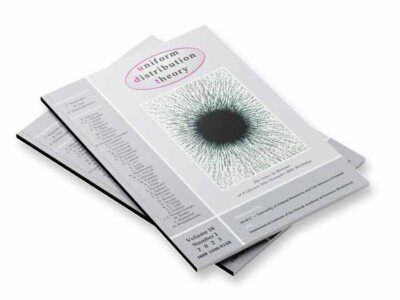

Volumes & Issues
Uniform Distribution Theory: Mathematics, Computational and Engineering Applications is an open-access, blind peer-reviewed academic journal dedicated to advanced research at the intersection of mathematics, computational science, and algorithmic methodologies. While its core focus remains on number theory and the theory of uniform distribution, the journal particularly emphasizes original contributions that address computational techniques, numerical algorithms, and their implementation in scientific and engineering applications.
The scope of the journal includes topics such as combinatorial and probabilistic number theory, sequence generation and analysis, discrepancy theory, quasi-Monte Carlo methods, Diophantine approximation, and computational approaches to numerical integration and stochastic simulation. These research areas are closely connected to algorithm design, high-performance computing, optimization, and data-driven modeling.
By promoting rigorous theoretical developments alongside computational and engineering-oriented perspectives, the journal provides a specialized platform for researchers interested in the design, analysis, and practical application of mathematical methods in computer science, simulation, cryptography, and computational engineering. Published periodically by a research institute of the Slovak Academy of Sciences, it contributes to the advancement of both fundamental mathematics and its translation into efficient computational frameworks and modern technological solutions.
Information for authors
Former publisher:
Institute of Mathematics of the Slovak Academy of Sciences, (Bratislava, Slovakia)
About the journal:
This journal aims to publish original research papers on various aspects of uniform distribution theory, with particular emphasis on computational methodologies, algorithmic developments, and engineering applications. It encourages interdisciplinary contributions that bridge number theory, computer science, artificial intelligence, scientific computing, cybersecurity, and computational engineering, fostering the transfer of mathematical advances into practical technological solutions.
We welcome submissions on topics including, but not limited to:
- Distribution of one-dimensional and multidimensional sequences
- Distribution of binary sequences
- Distribution of integer sequences and sequences from algebraic structures
- Distribution problems in finite abstract sets
- Continuously uniform distributions
- Discrepancies and their computational analysis
- Pseudo-random and quasi-random number generators
- Quasi-Monte Carlo integration and numerical methods
- Quasi-Monte Carlo applications in scientific computing and financial engineering
- Theory of densities and distribution functions
- Distribution of integer points in large domains
- Spectral properties and dynamics of sequences
- Number-theoretic cryptography, ciphers, and secure coding techniques
- Combinatorial number theory and trigonometric sums
- Diophantine approximations and Diophantine equations
- Continued fractions and computational number theory
- Quantum chaos and computational physics
- Algorithm design and complexity analysis based on uniform distribution theory
- Signal processing, data encoding, and information transmission using number-theoretic methods
- Modeling, simulation, and optimization of engineering systems through pseudo-random and quasi-random sequences
- Applications in embedded systems, real-time control, and autonomous technologies
- Machine learning, high-dimensional data analysis, and artificial intelligence supported by uniform distribution methods
- Cryptographic systems, cybersecurity, and secure communications
- High-performance computing and parallel numerical algorithms
- Randomized algorithms and stochastic simulation techniques
- Ethical and societal implications of pseudo-randomness and algorithmic fairness in intelligent systems
The primary AMS subject classifications include 11K (Probabilistic number theory), 11J (Diophantine approximation and transcendental number theory), 11B (Sequences and sets), 11L (Exponential sums and character sums), together with computationally oriented areas such as 68Q25 (Analysis of algorithms and problem complexity), 68W20 (Randomized algorithms), 65C10 (Random number generation), 94A60 (Cryptography), 68T09 (Computational aspects of Artificial Intelligence), and 68U20 (Simulation).
CHIEF EDITORS
Karpenkov, Oleg (Liverpool)
karpenk@liv.ac.uk
Lattice geometry, multidimensional continued fractions, geometry of numbers.
Nair, Radhakrishnan (Liverpool)
nair@liverpool.ac.uk
Ergodic theoretic aspects of uniform distribution, issues related to pointwise convergence, metrical theory of uniform distribution, exceptional sets, exponential sums, distribution of primes, densities and combinatorial number theory.
Pillichshammer, Friedrich (Linz)
friedrich.pillichshammer@jku.at
Discrepancy, digital nets, quasi-Monte Carlo integration, lattice rules, tractability of high-dimensional problems.
EDITORIAL BOARD
Akiyama, Shigeki (Tsukuba)
akiyama@math.tsukuba.ac.jp
Dynamics emerging from sequences, continued fractions, interplay between symbolic dynamics and number theory, spectral properties of sequences.
Allouche, Jean-Paul (Paris)
jean-paul.allouche@imj-prg.fr
Combinatorial number theory, continued fractions, automatic sequences.
Baláž, Vladimír (Bratislava)
vladimir.balaz@stuba.sk
Theory of densities, summation methods.
Berkes, István (Graz)
berkes@tugraz.at
Discrepancies, distribution of one dimensional and multidimensional sequences.
Bugeaud, Yann (Strasbourg)
bugeaud@math.unistra.fr
Diophantine approximation, diophantine equations, continued fraction, distribution modulo one.
Dick, Josef (Sydney)
josef.dick@unsw.edu.au
Quasi-Monte Carlo methods, digital nets and sequences, lattice rules, geometric discrepancy, uniform distribution on the sphere.
Drmota, Michael (Vienna)
michael.drmota@tuwien.ac.at
Continuous uniform distribution, discrepancies, distribution of one dimensional and multidimensional sequences.
Dubickas, Artūras (Vilnius)
arturas.dubickas@mif.vu.lt
Distribution modulo one, diophantine approximation.
Faure, Henri (Marseille)
henri.faure@univ-amu.fr
Distribution of one dimensional and multidimensional sequences, discrepancies, quasi-Monte Carlo integration.
García Guirao, Juan Luis (Cartagena, Spain)
juan.garcia@upct.es
Distribution of one-dimensional and multidimensional sequences.
Giuliano Antonini, Rita (Pisa)
giuliano@dm.unipi.it
Theory of densities, distribution functions of sequences, summation methods, continued fractions.
Grabner, Peter (Graz)
peter.grabner@tugraz.at
Point distributions on manifolds, extremal energy point sets, dynamical and fractal aspects of uniformly distributed sequences.
Grekos, Georges (Saint-Etienne)
grekos@univ-st-etienne.fr
Theory of densities, combinatorial number theory.
Grozdanov, Vasil (Blagoevgrad)
vassgrozdanov@yahoo.com
Well distributed sequences and nets, discrepancy and diaphony, applications of uniformly distributed sequences.
Gyarmati, Katalin (Budapest)
gykati@cs.elte.hu
Pseudorandomness, combinatorial number theory.
Konyagin, Sergei (Moscow)
konyagin23@gmail.com
Pseudorandom numbers generators, combinatorial number theory.
Kraaikamp, Cor (Delft)
c.kraaikamp@ewi.tudelft.nl
Metric properties of number theoretic expansions: beta-expansions, one and multi-dimensional continued fraction algorithms, Lüroth- and Engel series.
Kritzer, Peter (Linz)
peter.kritzer@oeaw.ac.at
Discrepancy, digital nets, lattice rules, quasi-Monte Carlo methods, tractability of multivariate problems.
Larcher, Gerhard (Linz)
Gerhard.Larcher@jku.at
Irregularities of distribution, discrepancy, diophantine approximation, low-discrepancy sequences, quasi-Monte Carlo methods, applications in finance.
Lev, Vsevolod (Haifa)
seva@math.haifa.ac.il
Combinatorial number theory, additive combinatorics.
Luca, Florian (Johannesburg)
Florian.Luca@wits.ac.za
Distributions of binary sequences, combinatorial number theory, diophantine approximations and diophantine equations, continued fractions.
Mišík, Ladislav (Ostrava)
ladislav.misik@osu.cz
The theory of generalized densities, measures on sets of integers.
Niederreiter, Harald (Linz, Salzburg)
ghnied@gmail.com
harald.niederreiter@oeaw.ac.at
All parts of uniform distribution theory.
Ohkubo, Yukio (Kagoshima)
ohkubo@eco.iuk.ac.jp
Distribution of one dimensional and multidimensional sequences, continuous uniform distribution, discrepancies. •
Paštéka, Milan (Bratislava)
pasteka@mat.savba.sk
Theory of densities, uniform distribution in groups and rings.
Pethő, Attila (Debrecen)
petho.attila@inf.unideb.hu
Diophantine equations, distribution of polynomials and algebraic numbers, radix representations, cryptography.
Pintz, János (Budapest)
pintz.janos@renyi.mta.hu
Analytic number theory, distribution of prime numbers.
Porubský, Štefan (Prague)
sporubsky@hotmail.com
Distribution functions of sequences, combinatorial number theory, arithmetic densities, arithmetic functions, summation methods, pseudorandom number generators, cryptography.
Sárközy, András (Budapest)
sarkozy@cs.elte.hu
Distribution of binary sequences, pseudorandom number generators, combinatorial number theory, character sums, number theoretic ciphers.
Shkredov, Ilya (Moscow)
ilya.shkredov@gmail.com
Combinatorial number theory, continued fractions.
Strauch, Oto (Bratislava)
oto.strauch@mat.savba.sk
The theory of distribution functions of sequences, discrepancies, metric theory of diophantine approximations.
Tezuka, Shu (Kyushu)
shu_tezuka@yahoo.co.jp
Quasi-Monte Carlo integration, quasi-Monte Carlo methods in financial mathematics, pseudorandom number generators.
Tichy, Robert F. (Graz)
tichy@tugraz.at
Discrepancies, quasi – Monte Carlo integration, quasi – Monte Carlo methods in financial mathematics, diophantine approximations and diophantine equations.
Tóth, János T. (Ostrava)
tothj@ujs.sk
Distribution of block sequences, various kinds of dense sequences.
Ustinov, Alexey. (Khabarovsk)
ustinov@iam.khv.ru
Trigonometric (exponential) sums, continued fractions, geometry of numbers.
Verger-Gaugry, Jean-Louis. (Le Bourget-du-Lac)
Jean-Louis.Verger-Gaugry@univ-smb.fr
Number theory, dynamics.
Weber, Michel (Strasbourg)
michel.weber@math.unistra.fr
Ergotic theory, pointwise convergence, probability theory.
Winkler, Reinhard (Vienna)
reinhard.winkler@tuwien.ac.at
Distribution of integer sequences and sequences from groups and generalized spaces, theory of distribution functions of sequences (limit measures), distribution of binary sequences, dynamic emerging from sequences.
Winterhof, Arne (Linz)
arne.winterhof@oeaw.ac.at
Pseudorandom numbers, measures of pseudorandomness, exponential sums, finite fields.
Woźniakowski, Henryk (New York, Warsaw)
henryk@cs.columbia.edu
Discrepancies, Quasi-Monte Carlo algorithms, Monte-Carlo algorithms, tractability of multivariate problems, computational complexity of continous problems.
Uniform distribution theory is covered by the following services:
- ROAD
- OpenAlex
- Baidu Scholar
- CNKI Scholar (China National Knowledge Infrastructure)
- Dimensions
- EBSCO
- ExLibris
- Google Scholar
- J-Gate
- Jisc – Open Policy Finder
- JournalGuide
- JournalTOCs
- KESLI-NDSL (Korean National Discovery for Science Leaders)
- MathSciNet
- Naver Academic
- Naviga (Softweco)
- ProQuest
- ReadCube
- ScienceON/AccessON
- SCILIT
- Scite_
- Semantic Scholar
- TDNet
- Ulrich’s Periodicals Directory/ulrichsweb
- WanFang Data
- WorldCat (OCLC)
- X-MOL
- zbMATH Open
Additionally, the journal is registered and indexed in the Crossref database.
- metrics.mcq 0,19
- metrics.googlescholar (h-index) 11
- metrics.googlescholar (i10-index) 12
- metrics.openalex (h-index) 8
- metrics.openalex (i10-index) 4
Submission Guidelines
Manuscripts submitted to Uniform Distribution Theory (UDT) must be original contributions and must not be under consideration for publication elsewhere. The journal accepts original research articles, review articles, and short communications.
Language
All manuscripts must be written in English. Authors who are non-native English speakers are strongly encouraged to have their manuscripts reviewed by a native English speaker before submission.
Manuscript File Formats
Manuscripts may be submitted in PDF, DOC, DOCX, or LaTeX (.tex / .zip) format. Where applicable, supplementary files should be included in a single ZIP archive. The maximum file size is 50 MB.
Manuscript Templates
Authors are strongly encouraged to use the official UDT LaTeX template or Word template available from the journal website. Authors should always use the most current version of the appropriate template when preparing their manuscript.
Manuscript Structure
Original research articles should include the following sections in the indicated order: Title, Author(s) and Affiliation(s), Abstract, Keywords, Introduction, Methods, Results, Discussion, Conclusion, Acknowledgements (if applicable), Conflict of Interest statement, and References.
Title, Authors and Affiliations
The manuscript should begin with the title of the article, followed by the full names of all authors and their institutional affiliations.
Abstract
The abstract must contain between 50 and 3000 words. It must be self-contained and should concisely state the purpose of the study, the methods or approach used, the principal results, and the major conclusions. The abstract must not contain references, abbreviations, or mathematical formulae.
Keywords
Authors should provide 4 to 8 keywords that accurately reflect the content of the manuscript. Keywords should not already be included in the article title.
Introduction
The Introduction should clearly define the research problem, provide the necessary scientific background, and explain the motivation and relevance of the study. Relevant published research should be appropriately discussed and cited, and the contribution of the present work should be clearly identified.
Methods
The Methods section should provide a clear description of the mathematical, theoretical, computational, analytical, or experimental methods used in the study. Mathematical formulations, assumptions, models, algorithms, and procedures should be presented with sufficient detail to allow the work to be understood and, where applicable, reproduced.
Results
The Results section should clearly present the principal findings of the research. Mathematical results, analytical findings, computational results, numerical experiments, and other relevant outcomes should be presented systematically using appropriately numbered equations, figures, and tables.
Discussion
The Discussion should provide a critical interpretation of the results and explain their significance in relation to the research problem and existing literature. Authors should highlight the main scientific contributions of the study and discuss relevant implications, limitations, and comparisons with previous research where appropriate.
Conclusion
The Conclusion should summarize the principal findings and clearly state the main scientific contribution of the work. Where appropriate, authors may also indicate possible directions for future research.
Acknowledgements
An Acknowledgements section may be included where applicable.
Figures and Tables
All figures and tables must be numbered consecutively and provided with descriptive captions. Figures should be supplied at a minimum resolution of 300 dpi for photographs and 600 dpi for line drawings. All figures should be embedded within the manuscript file.
Mathematical Expressions
All mathematical expressions and equations should be numbered and typeset clearly. Standard mathematical notation should be used wherever possible. Non-standard symbols must be defined at their first occurrence.
Abbreviations and Symbols
All abbreviations, acronyms, and non-standard symbols must be defined when they are first introduced in the manuscript.
References
References must be numbered consecutively according to their first appearance in the text and listed in the same order at the end of the manuscript. In-text citations should appear as superscript numbers or in square brackets, for example [1] or [1,2,5–7].
Journal Article
Author(s) (Year). Article title. Journal Name, Volume(Issue), pp. Start–End. DOI.
Book
Author(s) (Year). Title of Book. Publisher, Place of publication.
Chapter in a Book
Author(s) (Year). Chapter title. In: Editor(s) (Eds.), Title of Book, pp. Start–End. Publisher.
Authors should provide DOIs wherever available. References to unpublished work, personal communications, or websites should be kept to a minimum.
Authorship
All listed authors must have made a genuine scientific contribution to the work. Ghost authorship and gift authorship are not permitted. The corresponding author is responsible for ensuring that all co-authors have approved the final manuscript and agreed to its submission.
Originality
Submission of a manuscript implies that the work has not been published previously, except where permitted for an abstract or conference paper, is not under consideration by another journal, and has been approved for submission by all authors. Plagiarism in any form is unacceptable and may result in immediate rejection.
Conflict of Interest
Authors must disclose any financial or personal relationships that could inappropriately influence the submitted work. If no conflicts exist, authors should include the following statement: "The authors declare no conflict of interest."
Ethical Approval
Where applicable, studies involving human participants or animals must include a statement confirming that appropriate ethical approval was obtained.
Data Availability
Authors are encouraged to make their research data available as supplementary material or through an appropriate open repository and to include a data availability statement in the manuscript where applicable.
Peer Review Process
This journal follows a double-blind peer-review process. Manuscripts are initially screened by the Editor-in-Chief for scope and overall quality. Manuscripts that pass the initial screening are sent to at least two independent expert reviewers.
Double-Blind Peer Review
In the double-blind peer-review process, the identities of both the authors and reviewers are concealed throughout the review process. This approach is intended to reduce potential bias and ensure that manuscripts are evaluated primarily on their scientific quality, originality, methodological rigor, significance, and contribution to the field.
Peer Review Criteria
Reviewers evaluate manuscripts according to their scientific quality, originality, relevance to the journal's scope, significance of the contribution, methodological rigor, clarity of presentation, and compliance with appropriate academic standards.
Reviewers
Manuscripts that pass the initial editorial screening are evaluated by at least two independent expert reviewers. Reviewers are selected according to the subject area and scientific expertise required to assess the manuscript.
Editorial Decisions
Following the peer-review process, authors may receive one of the following decisions: Accept, Minor Revision, Major Revision, or Reject.
Review Time
The typical review time is approximately 6–10 weeks. The actual processing time may vary depending on the availability of suitable reviewers and the complexity of the manuscript.
Revised Manuscripts
When submitting a revised manuscript, authors must provide a point-by-point response addressing all reviewer comments and explaining the changes made to the manuscript. Revised manuscripts that do not adequately respond to the reviewers' concerns may be returned without further review.
Publication Fee / APC
No Article Processing Charge (APC) is required. Publication in Uniform Distribution Theory is free of charge for authors. Authors are not required to pay a publication fee for accepted manuscripts.
Copyright
Copyright and publishing rights remain with the authors unless otherwise agreed in writing. By submitting a manuscript, authors confirm that they have the right to submit and publish the work and that publication of the manuscript does not infringe the rights of any third party.
Submission System
All manuscripts must be submitted through the Cervantes editorial management system. Authors should submit their manuscripts through the UDT online submission system. Authors who are submitting for the first time should register for an account before submitting their manuscript.
Submission Requirements
Before submission, authors should ensure that the manuscript follows the journal's formatting requirements, contains all required sections, includes appropriate references, and has been approved for submission by all listed authors.
Contact Information
For enquiries regarding manuscript preparation or the submission process, please contact the editorial office at udt-journal@engineering-journals.org.
COPE Standards
This journal follows the ethical standards and Core Practices established by the Committee on Publication Ethics (COPE). Editors, authors, and reviewers are expected to comply with these principles, which promote transparency, integrity, and responsible conduct in scholarly publishing.
Zero Tolerance for Malpractice
The editorial board maintains a zero-tolerance policy toward publication malpractice. Submissions may be rejected if authors have committed serious ethical violations, including, but not limited to, plagiarism, duplicate submission, data fabrication, or other forms of academic misconduct.
Plagiarism Policy
The editorial board is participating in a growing community of Similarity Check System’s users in order to ensure that the content published is original and trustworthy. Similarity Check provides comprehensive manuscript screening to detect plagiarism and maintain a high standard of quality throughout the peer-review process.
Author Accountability and Verification
Authors are fully responsible for the accuracy, originality, and integrity of all submitted work, including any content edited or assisted by AI technologies. All manuscripts undergo an initial screening using specialized software to detect plagiarism and identify the undisclosed use of generative AI.
AI Guidelines for Authors (Simple Assistants)
Authors may use simple AI-assisted tools for limited purposes such as grammar correction, language translation, text formatting, or verification of statistical analyses. The use of these tools does not require disclosure, provided they do not generate original scientific content.
AI Guidelines for Authors (Generative AI)
Generative AI tools capable of producing original content, including manuscript text, literature reviews, tables, figures, or reference lists, must not be used to create the scientific content of a manuscript. Such tools may only be used for language editing, assistance with data analysis, or stimulus generation. If generative AI is used for these permitted purposes, authors must include a Disclosure of the Use of AI section describing the tools employed and their specific role in preparing the manuscript.
AI Guidelines for Reviewers and Editors
Editors and reviewers may use simple AI-assisted tools to improve the language of their reports or verify statistical analyses without disclosure. However, the use of generative AI to produce peer-review reports, editorial decisions, or manuscript evaluations is strictly prohibited to preserve the integrity and confidentiality of the review process.
Blind Peer Review
This journal follows a blind peer-review process in which submitted manuscripts are evaluated by independent experts without revealing the identity of the authors. This approach helps reduce bias and ensures that each manuscript is assessed solely on its academic quality, methodology, originality, and contribution to the field.
Open Access Statement
This is an open access journal that provides free, immediate, and unrestricted online access to all its published content for readers around the world.
Archiving
Engineering Journals archives the contents of this journal in Portico, a trusted digital preservation service that ensures the long-term accessibility and preservation of scholarly books, journals, and collections. In addition, the journal maintains an archive of all volumes published by the previous publisher from 2006 to 2022, available at https://udt.mat.savba.sk/.
Published by: Engineering Journals