

Volumes & Issues
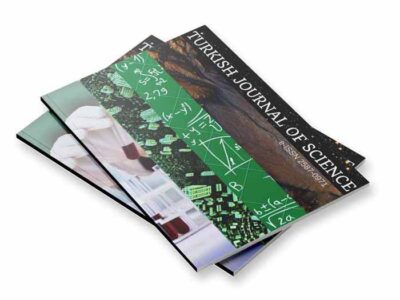
Turkish Journal of Science (TJOS) is an open-access, double-blind peer-reviewed academic journal dedicated to advancing original research at the intersection of mathematics and its engineering and computational applications. The journal provides a platform for researchers to present innovative ideas and original research articles with strong potential to drive technological and scientific innovation, with particular emphasis on work that translates theoretical mathematical developments into practical, applied, and engineering-oriented solutions.
TJOS publishes in English and follows a regular issue schedule, with releases in April–September and December each year. The journal prioritizes articles that are likely to engage researchers, engineers, and readers working across the mathematical and applied sciences, favoring contributions with clear potential for real-world implementation, computational relevance, and cross-disciplinary impact. Guided by a distinguished and expert editorial board, TJOS conducts its evaluation and publication processes under transparent and rigorous standards, ensuring that only original, high-quality, and technically sound work is selected for publication.
The journal welcomes submissions spanning the full breadth of mathematics and its engineering applications, with particular interest in areas including approximation theory, fractional calculus, applied functional analysis, linear algebra, discrete mathematics, combinatorics, control theory, financial mathematics, fuzzy sets and logic, game theory, graph theory, inverse problems, numerical analysis, and ordinary and partial differential equations — with an emphasis on their modeling, computational implementation, and application in engineering systems.
Information for authors
About the journal:
This journal aims to publish original research papers on various aspects of mathematics, with a strong emphasis on their engineering applications, computational implementation, and potential to drive technological innovation. Priority is given to work that bridges theoretical mathematical developments with practical, applied, and engineering-oriented solutions across scientific and industrial domains. It encourages contributions from researchers across all branches of mathematics, fostering the development of ideas that advance the field at both an intellectual and a technological level.
We welcome submissions on topics including, but not limited to:
- Approximation theory and its computational implementation
- Fractional calculus and applications in engineering modeling
- Applied functional analysis
- Linear algebra and matrix computation
- Discrete mathematics
- Combinatorics
- Control theory and systems engineering
- Financial mathematics and quantitative modeling
- Fuzzy sets and logic in intelligent systems
- Game theory and decision-making models
- Graph theory and network analysis
- Inverse problems in engineering and applied sciences
- Numerical analysis and scientific computing
- Ordinary and partial differential equations in engineering systems
The primary AMS subject classifications include 41A (Approximation theory), 26A33 (Fractional derivatives and integrals), 46-XX (Functional analysis), 15-XX (Linear and multilinear algebra; matrix theory), 05-XX (Combinatorics), 93-XX (Systems theory; control), 91G (Mathematical finance), 03E72 (Fuzzy set theory), 91A (Game theory), 05C (Graph theory), 35R30 (Inverse problems), 65-XX (Numerical analysis), and 34-XX/35-XX (Ordinary and partial differential equations).
CHIEF EDITORS
Akdemir, Ahmet Ocak (Ağrı İbrahim Çeçen University, Türkiye)
ASSOCIATE EDITOR
Dokuyucu, Mustafa Ali (Ondokuz Mayis University, Türkiye)
EDITORIAL BOARD
Abdeljawad, Thabet (Prince Sultan University, Saudi Arabia)
Akin, Elvan (Missouri University of Science and Technology, USA)
Alomari, Mohammad W. (University of Jerash, Jordan)
Nguyen Anh, Tuan (Thu Dau Mot University, Vietnam)
Butt, Saad Ihsan (COMSATS University Islamabad, Lahore Campus, Pakistan)
Nguyen, Huu Can (Ton Duc Thang University, Vietnam)
Çelik, Ercan (Kyrgyz-Turkish Manas University, Kyrgyzstan)
Dragomir, Sever Silvestru (Victoria University, Australia)
Ekinci, Alper (Bandırma Onyedi Eylül University, Türkiye)
Hammouch, Zakia (Moulay Ismail University, Morocco)
Jarad, Fahd (Çankaya University, Türkiye)
Pavic, Zlatko (University of Osijek, Croatia)
Qi, Feng (Henan Polytechnic University, China)
Ragusa, Maria Alessandra (University of Catania, Italy)
Set, Erhan (Ordu University, Türkiye)
Spalevic, Miodrag (University of Belgrade, Serbia)
Şenyurt, Süleyman (Ordu University, Türkiye)
Varosanec, Sanja (University of Zagreb, Croatia)
Zuherman, Rustam (University of Indonesia, Indonesia)
Turkish Journal of Science is covered by the following services:
- ASOS Index
- Dimensions
- Index Copernicus (ICI Journal Master List)
- J-Gate
- ResearchBib
- Scientific Indexing Services (SIS)
- Journal factor
- Google Scholar
- Cosmos Impact Factor
- Index of Academic Documents (IAD)
Additionally, the journal is registered and indexed in the Crossref database.
- metrics.cosmos 2,467 (2019)
- metrics.googlescholar (h-index) 16
- metrics.googlescholar (i10-index) 29
COPE Standards
This journal follows the ethical standards and Core Practices established by the Committee on Publication Ethics (COPE). Editors, authors, and reviewers are expected to comply with these principles, which promote transparency, integrity, and responsible conduct in scholarly publishing.
Zero Tolerance for Malpractice
The editorial board maintains a zero-tolerance policy toward publication malpractice. Submissions may be rejected if authors have committed serious ethical violations, including, but not limited to, plagiarism, duplicate submission, data fabrication, or other forms of academic misconduct.
Plagiarism Policy
The editorial board is participating in a growing community of Similarity Check System’s users in order to ensure that the content published is original and trustworthy. Similarity Check provides comprehensive manuscript screening to detect plagiarism and maintain a high standard of quality throughout the peer-review process.
Author Accountability and Verification
Authors are fully responsible for the accuracy, originality, and integrity of all submitted work, including any content edited or assisted by AI technologies. All manuscripts undergo an initial screening using specialized software to detect plagiarism and identify the undisclosed use of generative AI.
AI Guidelines for Authors (Simple Assistants)
Authors may use simple AI-assisted tools for limited purposes such as grammar correction, language translation, text formatting, or verification of statistical analyses. The use of these tools does not require disclosure, provided they do not generate original scientific content.
AI Guidelines for Authors (Generative AI)
Generative AI tools capable of producing original content, including manuscript text, literature reviews, tables, figures, or reference lists, must not be used to create the scientific content of a manuscript. Such tools may only be used for language editing, assistance with data analysis, or stimulus generation. If generative AI is used for these permitted purposes, authors must include a Disclosure of the Use of AI section describing the tools employed and their specific role in preparing the manuscript.
AI Guidelines for Reviewers and Editors
Editors and reviewers may use simple AI-assisted tools to improve the language of their reports or verify statistical analyses without disclosure. However, the use of generative AI to produce peer-review reports, editorial decisions, or manuscript evaluations is strictly prohibited to preserve the integrity and confidentiality of the review process.
Blind Peer Review
This journal follows a blind peer-review process in which submitted manuscripts are evaluated by independent experts without revealing the identity of the authors. This approach helps reduce bias and ensures that each manuscript is assessed solely on its academic quality, methodology, originality, and contribution to the field.
Open Access Statement
This is an open access journal that provides free, immediate, and unrestricted online access to all its published content for readers around the world.
Archiving
Engineering Journals archives the contents of this journal in Portico, a trusted digital preservation service that ensures the long-term accessibility and preservation of scholarly books, journals, and collections.